Eyewitness Dr Eva Umlauf Visits Salem
“Remembering is working towards the future” – this quotation by cultural scholar Aleida Assmann succinctly captures why engaging with the history of National Socialism remains an indispensable part of school education. For young people in particular, it is vital to understand where exclusion, antisemitism and the disregard of democratic values can lead.
In the Year 9 curriculum in Baden-Württemberg, the topic of National Socialism is firmly embedded. At Salem, however, it is not confined to classroom lessons alone. A particular emphasis is placed on the biographical project, within which pupils engage in depth with the individual life stories of those who were persecuted. Encounters with contemporary witnesses form an invaluable element of this work.
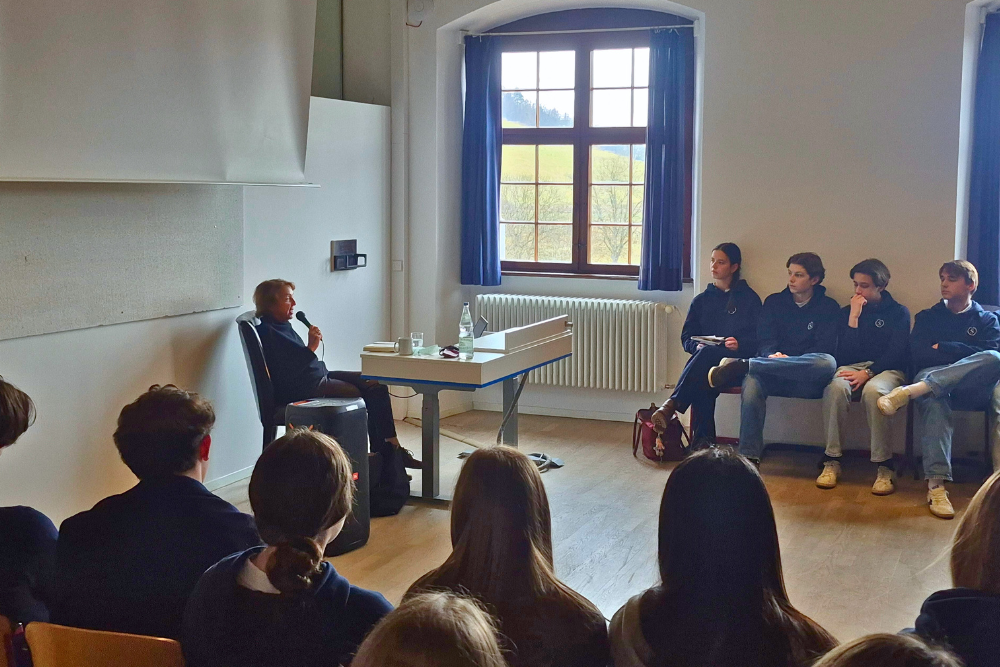
This academic year, Year 9 and the A-level History course once again had the special opportunity to speak with Eva Umlauf. On 4 February, she visited Schule Schloss Salem and gave a deeply moving account of her life. As a small child, she survived the Auschwitz concentration camp together with her mother.


She was born in 1942 in the Slovak labour camp Nováky. In 1944, she was deported to Auschwitz on one of the last transports. Her father was forced onto one of the so-called death marches to the Mauthausen concentration camp, where he died from the effects of sepsis. On 27 January 1945, mother and daughter were liberated by the Red Army. After returning to Slovakia, they learned that almost their entire family had been murdered.
Particularly affecting for the pupils was her description of the moment when a camp doctor said to her mother: “Forget the child – she will not survive.” That Eva Umlauf now speaks to young people as a doctor, author and committed eyewitness is a powerful testament to resilience and human strength.
Today she lives in Munich and has written two books reflecting on her experiences. In March 2025, she was elected President of the International Auschwitz Committee. In this role, she represents the interests of the last surviving victims of the Shoah and advocates for the preservation of remembrance.
In discussion with the pupils, it became clear how profoundly personal encounters deepen historical understanding. The prisoner number tattooed on her arm, still visible today, makes history tangible and immediate. The questions that followed her talk showed how thoughtfully the young people had engaged with what they had heard.
Against the backdrop of the resurgence of far-right movements and rising antisemitism, Eva Umlauf emphasised the responsibility of the younger generation to safeguard democracy actively and to stand up against all forms of hatred and inhumanity.
For the pupils, as well as for the teachers and guests in attendance, the encounter was a deeply formative experience. Our sincere thanks go to the Friends of Salem, who made this important visit possible. A visit to the Dachau Concentration Camp Memorial Site in March will further deepen this engagement and provide an opportunity for reflection and consolidation with the pupils.